Project Jupiter Will Bring More Than $4.7 Billion to New Mexico and Hundreds of Jobs for State Residents
Austin, Texas—Jul 28, 2026
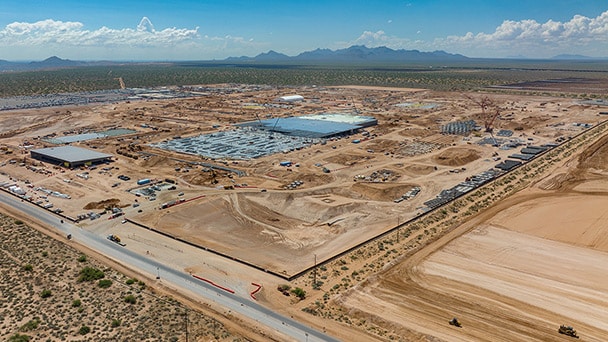
Oracle today announced that Project Jupiter has already delivered nearly $80 million in tax revenue and is expected to deliver more than $4.7 billion in long-term economic impact to the state and county from tax revenue, investments, and additional commercial activity.* To date, the project has funded 80% of its $50 million commitment to support local water infrastructure in Doña Ana County, with the remaining funding expected next month. It also generated $10 million in tax revenu/e for Doña Ana County and $29.9 million for the State of New Mexico from January through May 2026. The data center is being built by New Mexicans, with nearly 700 residents working onsite to date and hundreds more expected to be employed in the coming months.
Bringing Jobs to New Mexico
These results reflect Project Jupiter’s expanding investment in local jobs, community priorities, and long-term economic growth across southern New Mexico. The project is now on pace to create more than 7,000 construction jobs, including many union jobs, and 1,500 ongoing project-supported jobs once construction is complete.
“Project Jupiter is a responsible data center that is delivering tangible, growing value for Doña Ana County today,” said Mahesh Thiagarajan, executive vice president, Oracle Cloud Infrastructure. “Fulfilling our $50 million water infrastructure commitment this summer, generating nearly $10 million in local tax revenue, and creating more than 700 good-paying jobs for New Mexicans reflects our commitment to being a good neighbor and delivering lasting, generational benefits to the community we’re proud to join.”
Significant Community Investment
During construction, the project is estimated to generate tax revenues of approximately $600 million total, including $200 million to the county and $400 million to the state of New Mexico. Once operational, Project Jupiter is projected to have an ongoing gross receipts tax impact of more than $10 million annually for the county and more than $30 million to New Mexico—totaling $680 million over 17 years. In addition, the project will make payments of $12 million per year directly to the county and local schools through the Industrial Revenue Bond.
Tax revenues have already helped fund important local programs including generators for fire stations, food pantry renovations, improved roads, and funding for Doña Ana County schools. Project Jupiter has also fulfilled its $1.5 million commitment to the Boys & Girls Club of Las Cruces as part of a $6.9 million investment in workforce development and other community programs.
Project Jupiter is expected to generate approximately $384 million in annual economic impact during construction and $113 million annually once operational.
$4.7 Billion in Long-Term Economic Impact*
| Economic Impact | Annual Average | Duration (Years) | Total |
|---|---|---|---|
| Gross Receipts Tax / Sales Tax During Construction | 3 | $600M | |
| Additional Estimated Economic Activity During Construction | ~$384M | 3 | $1.15B |
| Gross Receipts Tax / Sales Tax During Operations (1)(2) | $40M | 17 | $680M |
| Additional Economic Activity During Operations (1)(2) | ~$113M | 17 | $1.92B |
| Industrial Revenue Bond – Schools, Infrastructure, Services (3) | $12M | 30 | $360M |
| Workforce Development & Community Programs (4) | $6.9M |
1 Provided by expert 3rd party consultant.
2 The estimates provided in this report are based on the best information available and all reasonable care has been taken in assessing the quality of that information. These estimates are intended to provide a good indication of likely future outcomes and should not be construed to represent a precise measure of those outcomes. To estimate the likely local economic impact attributable to the proposed project, we use a regional economic impact model called IMPLAN.4 - one of the most used economic impact models in the United States. Like all economic impact models, the IMPLAN model uses economic multipliers to quantify economic impacts.
3 IRB period is for 30 years.
4 Based on community benefits agreement.
Responsible Energy and Water Strategy
Project Jupiter’s updated design will significantly reduce ongoing water use and will not use any potable water for cooling or fuel cell operation. Similar to our data center’s closed-loop cooling system, Bloom Energy’s fuel cells require a one-time startup fill and only limited water for maintenance. Averaged over 15 years, the data center cooling and fuel cell systems together are expected to use about as much water each year as nine U.S. households. Water for startup and maintenance of the data center and fuel cell systems will come from non-potable water, while community drinking water will be limited to ordinary employee needs such as kitchens and restrooms.
The Bloom Energy fuel cells will power the campus through an onsite microgrid, replacing the previously planned gas turbines and diesel generators. Compared with the prior gas turbine plan, the updated energy design is expected to reduce nitrogen oxide emissions by approximately 92 percent.
Oracle will pay for the project’s energy infrastructure and electricity costs, so residents are not asked to fund Project Jupiter’s power needs through their electric bills. Project Jupiter is also committed to 100% carbon-free energy matching by 2031, and we will reach New Mexico’s Energy Transition Act (ETA) goals prior to 2045.*
Residents can learn more at ProjectJupiterTogether.com.
*Our commitments and projections for tax revenues, jobs, investment and economic impact assume the air permit and pipeline are approved, as originally planned.
Contact Info
About Oracle
Oracle offers integrated suites of applications plus secure, autonomous infrastructure in the Oracle Cloud. For more information about Oracle (NYSE: ORCL), please visit us at www.oracle.com.
Trademarks
Oracle, Java, MySQL, and NetSuite are registered trademarks of Oracle Corporation. NetSuite was the first cloud company—ushering in the new era of cloud computing.
Forward-Looking Statements Disclaimer
Statements in this article relating to Oracle’s future plans, expectations, beliefs, and intentions are “forward-looking statements” and are subject to material risks and uncertainties. Many factors could affect Oracle’s current expectations and actual results, and could cause actual results to differ materially. A discussion of such factors and other risks that affect Oracle’s business is contained in Oracle’s Securities and Exchange Commission (SEC) filings, including Oracle’s most recent reports on Form 10-K and Form 10-Q under the heading “Risk Factors.” These filings are available on the SEC’s website or on Oracle’s website at oracle.com/investor. All information in this article is current as of July 28, 2026 and Oracle undertakes no duty to update any statement in light of new information or future events.